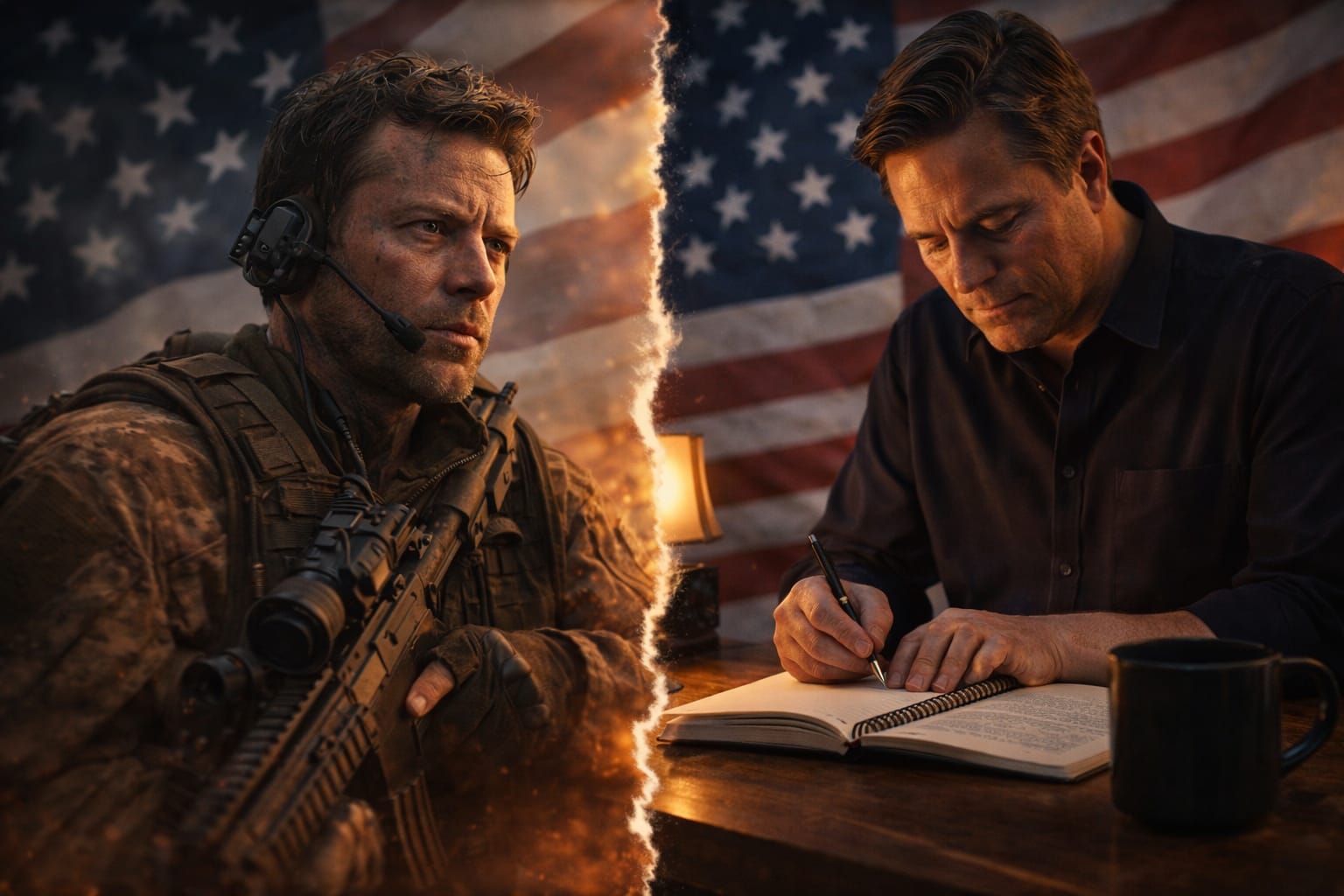
I wrote a letter to Tom Clancy once. Years ago, long before The Tempest Toss had a title or a first chapter. I wanted to ask a dead-serious question from a man who had built a career on it: how do you tell the truth about something dangerous without telling secrets you’re not allowed to tell? I never got an answer. But I think I figured out the answer anyway, and it’s the reason I wrote a novel instead of a white paper.
The record can’t say certain things. Fiction can.
What a Report Can’t Do
I spent twenty-two years as a chemist. I know what a technical document looks like. It’s accurate. It’s careful. It’s footnoted into oblivion. And almost nobody reads it.
That’s not a knock on the people who write those documents. It’s just the nature of the form. A government report on infrastructure vulnerability has one job: be correct and survive review. It is not allowed to grab you by the collar. It is not allowed to make you feel the lights going out, the gas pumps dead, the hospital generators coughing and then quitting. A report tells you a transformer can fail. A story makes you stand in the dark next to your kid and understand what that failure costs.
There’s also the classification problem. A lot of what we know about real threats sits behind clearances. People who served, people who studied this for a living, they carry knowledge they can’t put in a memo for the public. I corresponded with some of them while I worked on the book. I even traded letters with a former KGB general, a man who’d lived on the other side of the standoff I grew up under. None of them handed me secrets. They didn’t need to. What they gave me was something better for a novelist: the shape of the truth. The texture. The plausible.
And fiction is allowed to carry plausible truth out into the open where people will actually pick it up.
The Trojan Horse Has a Track Record
This isn’t a theory I invented to feel important about writing thrillers. There’s a paper trail.
Start with the obvious one. Clancy published The Hunt for Red October in 1984 through the Naval Institute Press, of all places. President Reagan got it as a Christmas gift and called it “the perfect yarn”, and that single endorsement did more than sell books. After it came out, the Pentagon started debriefing Clancy, and his novels became required reading at military colleges. A debut novelist, formerly an insurance salesman, ended up in rooms at the CIA and the NSA. A made-up submarine chase opened doors that no report ever opened.
Now go back one year, to 1983. Reagan watched a movie at Camp David called WarGames, about a teenager who nearly starts a nuclear war by dialing into a military computer. The story unsettled him enough that he turned to his advisors and asked whether something like that could really happen. According to multiple accounts, his interest in the film fed directly into NSDD-145, the first presidential directive on computer security, and clips from the movie were shown in congressional hearings as lawmakers wrote the country’s first anti-hacking laws. A piece of fiction did what a stack of vulnerability assessments hadn’t managed to do. It made a president ask the right question out loud.
It still happens. In 2015, the analyst P.W. Singer and the journalist August Cole published Ghost Fleet, a novel about a future war with China that hinges on cyberattacks and compromised supply chains. The book carries hundreds of footnotes tying every invented event back to a real-world source, and it ended up as fodder for training and briefings across the military and even for National Security Council staff. They called it a novel. They used it like a warning.
Three different decades. Same pattern. The story got through the door the document couldn’t.
Why the Story Gets Through
I think it comes down to how people actually take in a threat.
Tell someone a fact and they file it. Tell someone a story and they live inside it for a few hours. They make decisions alongside your characters. They feel the cost before the disaster arrives, which is the only time feeling the cost is useful. A risk you’ve imagined in detail is a risk you can no longer pretend isn’t there.
That’s the whole game with the kind of threat I write about. An electromagnetic pulse is not science fiction. The physics is real, the history is real, and you can read about it in the hard science behind the threat without me dressing it up at all. But “the grid is vulnerable to EMP” is a sentence people nod at and forget. Put a reader on a ship when the systems die, give them a character they care about and a clock that’s running, and suddenly the sentence has weight. They don’t forget. That’s not manipulation. That’s just the difference between knowing a thing and understanding it.
The Part That Keeps Me Honest
Here’s where I have to be careful, and I want to say it plainly because it matters.
A novel can carry truth, but it can also carry nonsense dressed up as truth, and the reader can’t always tell the difference. That’s the danger of the Trojan horse. Whatever you smuggle inside, people will believe it a little more than they should, simply because it moved them. So if you’re going to use fiction to say what the record can’t, you’d better get the record right first.
I take that seriously. The science in my book is real science. The Cold War history is real history. I did the homework, talked to the people who were there, and built the made-up parts on a foundation of true ones. I’ve written before about the responsibility that comes with writing about service, and this is the other half of it. You earn the right to move people by refusing to lie to them about the things that are real.
That’s the line I try to walk. Tell a story good enough that people feel the danger. Ground it well enough that the danger they feel is the actual one.
The Tempest Toss is the first time I’ve tried to do both at once. It’s Book 1 of the John Hunter series, out this fall, and you can read more about the book if you want to see whether I pulled it off.
I never heard back from Clancy. But I think he’d have understood the impulse. Some truths are too important to leave in a file nobody opens. Sometimes you have to wrap them in a story and hand them to people who’ll actually take them home.
The Tempest Toss is available now on Amazon
Book 1 of the John Hunter series. Real EMP science, Cold War history, and twenty-two years of research. Paperback and Kindle.