The first time I described a missile launch on the page, I deleted it. Then I wrote it again. Then I deleted that too.
Not because the prose was bad. Because I kept hearing a voice in my head asking a simple question. Would somebody who actually stood that watch read this and wince? Would they recognize the work, or would they see a writer playing dress-up with their life?
That question follows me through every chapter of The Tempest Toss. It’s the reason I write slower than I’d like. And it’s the closest thing I have to a creed.
You’re borrowing someone else’s life
Fiction about service is a strange kind of borrowing. You take real jobs, real fears, real chains of command, and you bend them toward a story that never happened. That’s allowed. That’s the whole point of a novel. But there’s a line between using a thing and abusing it, and the line matters more when the thing is a person who raised their right hand and meant it.
I spent twenty-two years as a chemist. I know what it feels like when a movie or a book gets my world wrong. The lab scene where the genius mixes two beakers and saves the day. The hand-wave where chemistry becomes magic. It’s not offensive, exactly. It’s just lazy. It tells me the writer didn’t care enough to ask.
Now imagine that carelessness aimed at something with real stakes. A boarding. A search and rescue in heavy seas. A watch that runs eighteen hours because the relief never came. People do those jobs. Some of them don’t come home. When you write that world badly, you’re not just being lazy. You’re telling everyone who lived it that their reality was a prop.
So the first responsibility is plain.
Get it right out of respect. Not to impress the experts. To honor the people who can’t unsee the truth.
The temptation to make it shine
There’s a second trap, and it’s seductive. Glamour.
Military thrillers run on tension and competence, and it’s easy to tip those into a recruiting poster. The hero never hesitates. The hardware never jams. The cost never lands. You can sell a lot of books that way. Readers like winners.
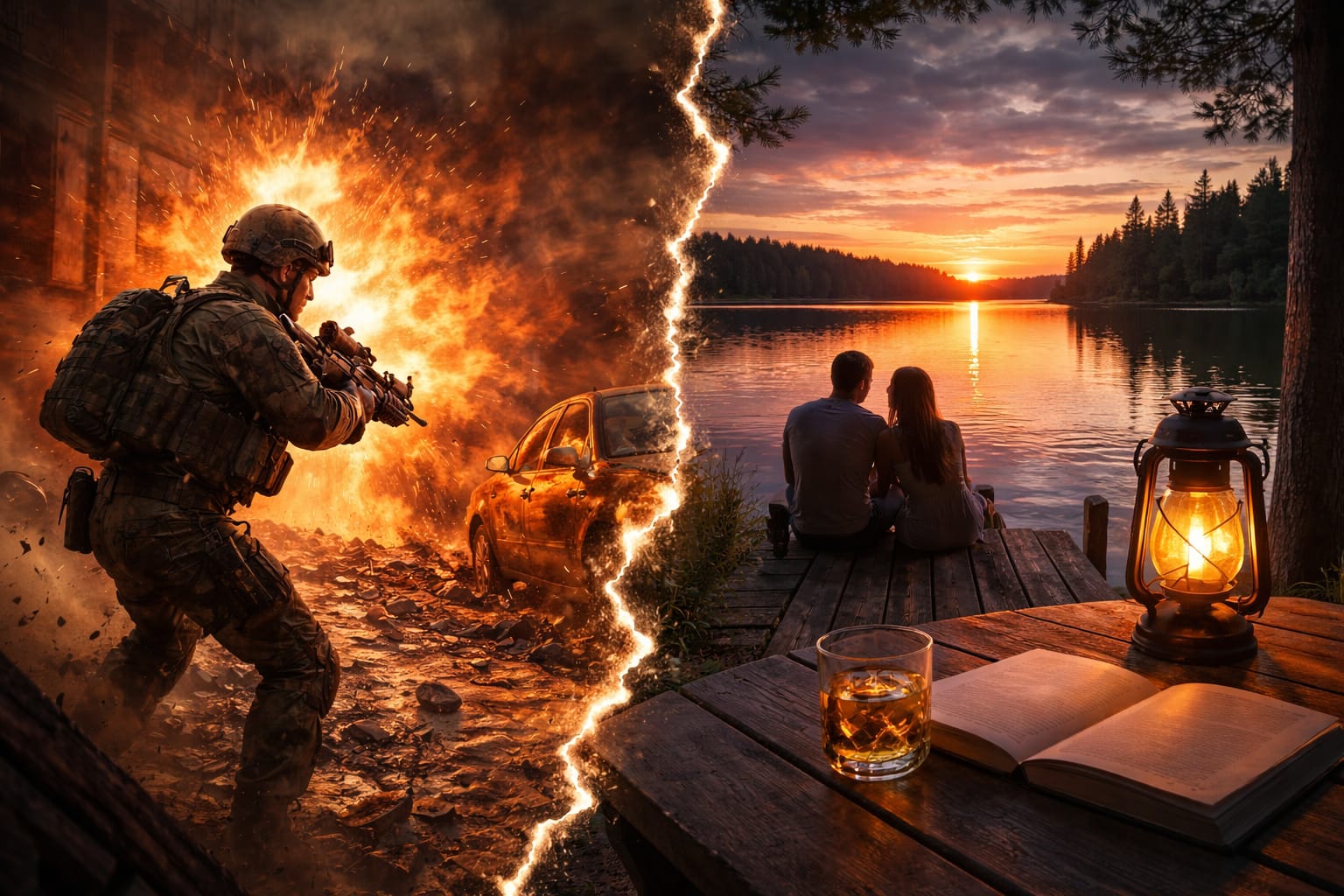
But I think that version lies, and not in a small way. Service has a price, and pretending otherwise cheapens the people who actually pay it. The exhaustion. The decisions you replay for years. The families on the other end of a deployment. If I write a character who serves and feels nothing, I’ve written a video game, not a person.
I’m not interested in misery for its own sake either. That’s just the opposite distortion wearing a serious face. The honest middle is harder. Show the competence and the cost. Let the hero be good at the job and still pay for it. John Hunter, my lead, is sharp and capable. He’s also tired in ways that don’t show up on a fitness report. Both things are true at once. That’s the part I refuse to flatten.
I wrote more about why fiction reaches places the official record can’t in a separate essay on what novels can say that documents cannot. The short version: the made-up story can carry the emotional truth the after-action report leaves out. That power only works if you handle it with care.
Real threats deserve real homework
The Tempest Toss is built around EMP. High-altitude electromagnetic pulse. The kind of event that could take down a power grid and the electronics riding on it.
This is where the chemist in me refuses to bluff. EMP is not a fantasy weapon I invented for plot convenience. The phenomenon is real, and it has a history. In July 1962, the United States detonated a 1.4-megaton warhead about 250 miles above the Pacific in a test called Starfish Prime. The pulse was far larger than the scientists expected. It knocked out streetlights and tripped alarms in Hawaii, hundreds of miles from the burst.
Decades later, Congress took the threat seriously enough to stand up a formal study, the Commission to Assess the Threat to the United States from Electromagnetic Pulse Attack. I read that material. Not to dump it on the page, but to make sure that when my story leans on the science, it leans on something that can hold weight.
Writing about a real national-security threat carries its own responsibility. You can’t be reckless. There’s a difference between dramatizing a known, openly documented danger and writing a how-to manual. I keep my fiction on the side of the public record. The goal is to make readers feel the stakes, not to hand anyone a blueprint. If a scene would teach a bad actor something they couldn’t already find in a Wikipedia article, I cut it. That’s a rule I don’t bend.
I dug into the craft side of this balance in my piece on writing military fiction that earns its details. Research is the easy half. Knowing what to leave out is the hard half.
What the Coast Guard connection means to me
I’m a member of the U.S. Coast Guard’s Authors Program, and I don’t treat that lightly.
What it represents is accountability. When you write inside a community of people who actually did the work, you can’t hide behind invention. Somebody in that circle has stood the watch you’re describing. That’s a gift and a check at the same time. It keeps me honest in a way that no amount of solo research could.
It also reminds me that the Coast Guard is a service most thriller readers underestimate. It runs toward storms. It does the search and rescue, the interdiction, the dangerous unglamorous work that rarely makes the trailer. Writing into that world, with people who know it from the inside reading over my shoulder, is the best possible pressure. You can read what the service actually does at the official U.S. Coast Guard site. It’s more than most people assume.
The promise I make to the reader
Here’s where I land. Every novel about service is a kind of promise. The writer promises that the respect is real, that the research is honest, and that the people on the page are people, not action figures.
I won’t pretend I always hit it. I’ll get details wrong. Somebody who served will catch a mistake, and I’ll be glad they did, because that’s how you get better. But the intent has to be right from the start. Write it straight. Don’t glamorize the cost away. Don’t distort a real danger into cheap spectacle. And remember, always, that you’re holding something that belongs to other people.
That deleted missile scene? I rewrote it a fourth time. Slower. Plainer. With the cost left in. It’s better now. Not because it’s prettier. Because it’s true to the people who’d recognize it.
If you want to know more about where I come from and why this matters to me, my about page lays it out. And if you want to see how all of this turns into a story, the book is where the promise gets tested. That’s the only place it counts.
The Tempest Toss is available now on Amazon
Book 1 of the John Hunter series. Real EMP science, Cold War history, and twenty-two years of research. Paperback and Kindle.