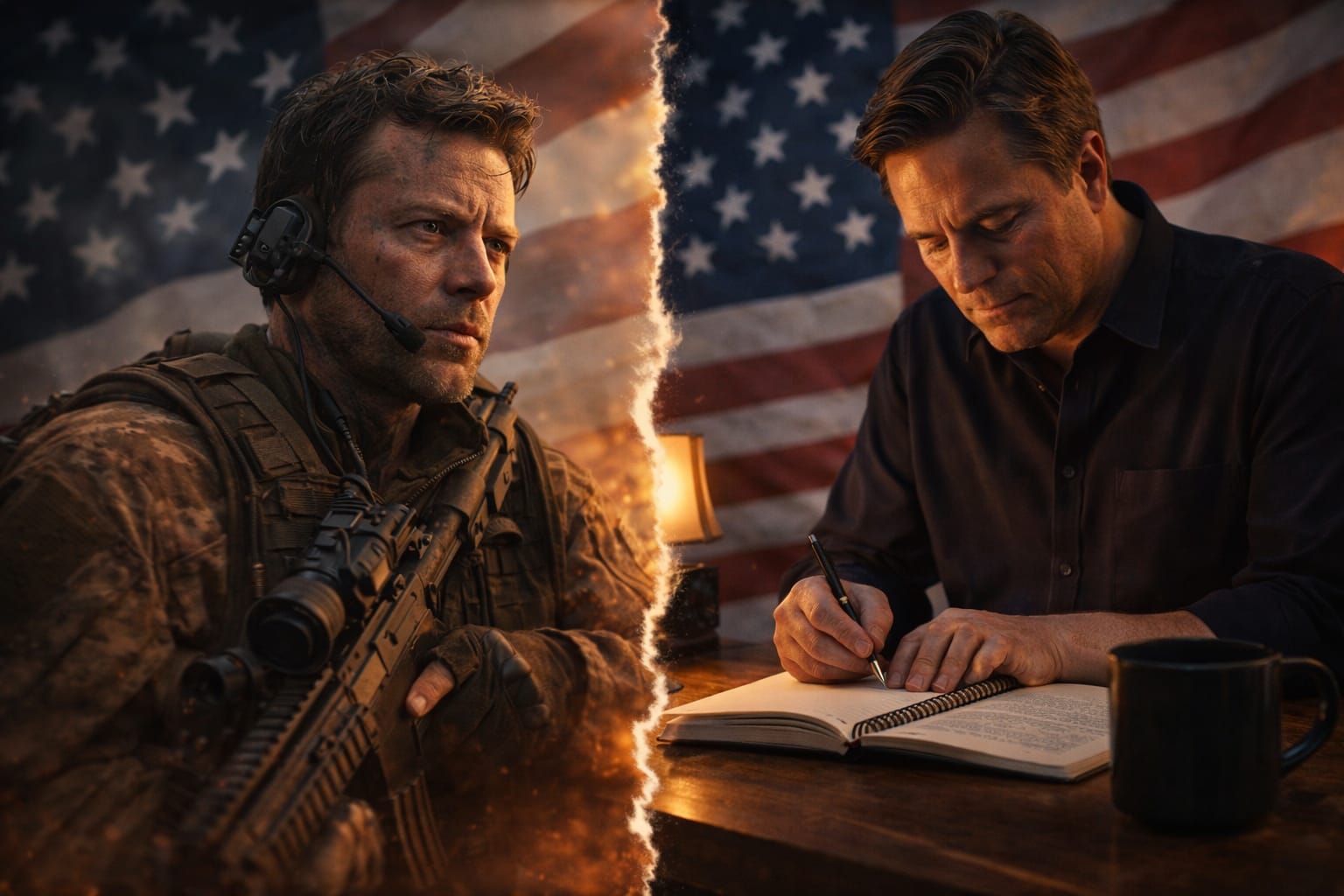
The first draft of The Tempest Toss opened with a missile launch, a power grid going dark across the eastern seaboard, and a firefight on the deck of a cutter. All in chapter one. I was proud of it. Then a friend who reads more thrillers than I do handed it back and said, “I got bored around page eleven.” Bored. With explosions. That sentence taught me more about pacing than any craft book ever did.
Here’s the thing nobody tells you when you start writing action.
Nonstop tension isn’t tension. It’s noise. And the reader stops hearing it.
Why wall-to-wall action goes numb
Tension is a contrast effect. You feel the spike because there was a baseline. If everything is a spike, the reader’s brain recalibrates and the new normal becomes loud, and loud stops meaning anything. It’s the same reason you stop noticing a smoke alarm chirping in another room after twenty minutes. The signal hasn’t changed. Your sensitivity has.
I think of it in terms of the work I did as a chemist for two decades. You can’t read a meaningful peak on a noisy baseline. You have to quiet the system first. A reader is an instrument too. Give them a flat, quiet stretch and the next jolt registers off the chart. Give them jolt after jolt and they flatten out.
So the loud scenes in my book exist because of the quiet ones. Not in spite of them.
Quiet beats are not filler
This is the part aspiring writers resist, because “quiet” sounds like “slow,” and slow sounds like the thing agents reject. But a quiet beat isn’t a lull. It’s a loaded gun on the table.
A good quiet scene does three jobs at once. It lets the reader breathe. It deepens character so the next danger actually costs something. And it plants the thing that pays off later. John Hunter sitting in a diner at 2 a.m., not talking, turning a coffee cup, is not a break from the plot. It’s where I show you what he’s afraid of losing. Forty pages later, when that exact thing is on the line, you already care. I didn’t have to stop and explain why it matters. The diner did that.
Elmore Leonard had a rule for this, sort of in reverse. His tenth rule was to try to leave out the part that readers tend to skip. People skip thick paragraphs of weather and backstory. They don’t skip a tense conversation where two people want different things. So my quiet beats are never quiet on the page. There’s a current under them. Somebody wants something they can’t say out loud. That’s still pressure. It’s just pressure you can hear yourself think over.
Structure scenes to end on a tilt
Here’s a concrete technique you can use tonight.
Every scene should end at a slightly different altitude than where it started. Up or down, doesn’t matter. What matters is the tilt. The character knows something they didn’t, or wants something new, or the ground shifted under them. If a scene ends exactly where it began, cut it or fold it into the scene next door.
I write a one-line tag for every scene in a column to the right of my outline. Start state, end state. “Thinks the leak is contained” to “knows it isn’t.” “Trusts her” to “almost trusts her.” When two scenes in a row have the same tilt, the same shape, I feel the slack immediately. The reader feels it too, they just can’t name it. They call it “draggy” and put the book down.
The chapter break is a tool, not a wall
Most new writers end a chapter when a scene ends. Natural. Also a missed opportunity.
End the chapter one beat before the scene resolves. Mid-reach. The hand is on the door, the radar paints a contact, the phone rings and the caller ID is a dead man’s name. Then cut to white space. The reader’s eye is already moving to the next chapter before they’ve decided to keep reading. That’s not a trick. That’s just respecting how attention works.
But, and this matters, you can’t do it every time. If every chapter ends on a cliff, the cliffs flatten out, same numbing problem as before. So I alternate. Some chapters end on a hard hook. Some end on a soft landing, a moment of quiet that lets the reader set the book down feeling satisfied instead of yanked. The satisfied ones are what make them trust you enough to pick it back up.
The ticking clock, used honestly
A deadline is the cheapest way to manufacture tension and the easiest to fake. “He had 24 hours.” Fine. But readers can smell an arbitrary clock. If the 24 hours could just as easily be 48 with no real difference, the clock is decoration.
The clock has to be load-bearing. In my book the timeline comes from real physics, not from me needing a countdown. An EMP event has consequences that cascade on their own schedule, batteries, backup generators, the cold chain in hospitals. I leaned on the actual science there, the same way I tried to in all the operational research behind the book. When the clock comes from the world instead of from the writer’s convenience, the reader stops checking their watch and starts feeling the heat. The deadline isn’t imposed. It’s discovered.
Earn the payoff, then get out
Kurt Vonnegut’s advice was to be a sadist and make awful things happen to your characters so the reader sees what they’re made of. He’s right. But the sadism only lands if you’ve made the reader love the character first. That’s what the quiet scenes bought you. The diner, the coffee cup, the thing he’s afraid to lose. You spent pages building it so the payoff would hurt.
And when the payoff comes, write it lean. The big scene is not where you slow down and admire your prose. It’s where you tighten. Short sentences. Hard verbs. Get in, do the damage, get out. I’ve watched writers blow a climax by lingering, by explaining the emotion instead of letting it hit. Trust the runway you built. The plane will land itself.
That early draft of mine, the one with three explosions before page eleven, is gone now. What replaced it opens quieter. A man checks a weather buoy that’s reading wrong. That’s it. But by the time the missile actually flies, you know exactly what’s at stake, and it lands like a hammer instead of a firework.
Pacing isn’t about going fast. It’s about controlling the reader’s pulse, slow then quick, so they never quite catch their breath but never go numb either. That rhythm is most of the craft of writing military fiction that holds a reader. It’s most of what I learned writing The Tempest Toss. You can see how it came out in the John Hunter series. I’d rather you feel the quiet parts than skip them.
The Tempest Toss is available now on Amazon
Book 1 of the John Hunter series. Real EMP science, Cold War history, and twenty-two years of research. Paperback and Kindle.