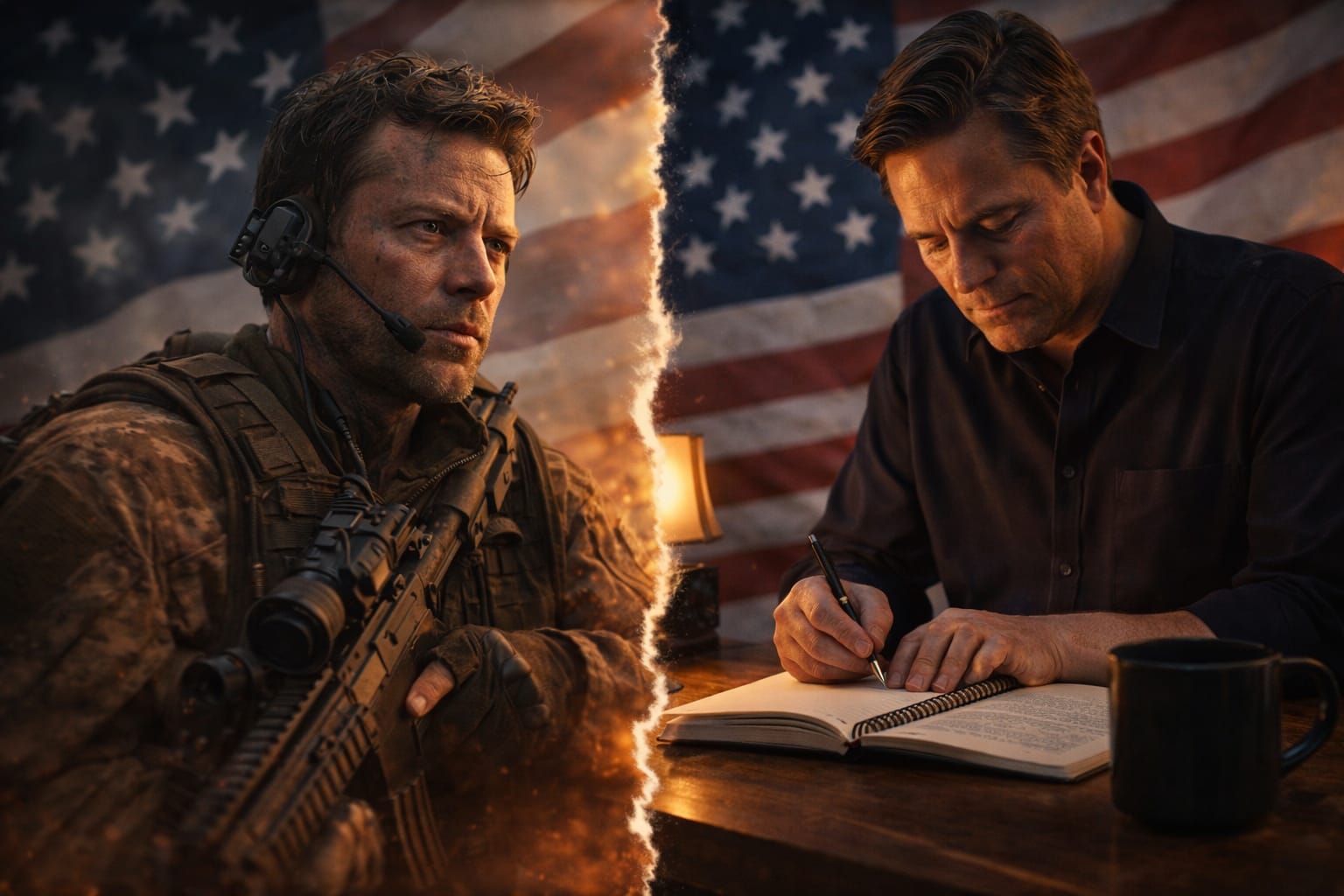
I spent twenty-two years getting one scene right.
It’s a single chapter in The Tempest Toss. A small team, a tight window, gear that has to work, a chain of command that does not bend for the convenience of the plot. On paper, maybe nine pages. In practice, the better part of two decades of phone calls, dead ends, declassified documents, and one long correspondence with a man who used to run agents against my country. I’ll get to him.
People assume the research that goes into a thriller is the stuff you can see. The acronyms. The hardware. The procedural detail that signals “this writer did the homework.” Some of that’s true. But the research I’m proudest of is the research you’ll never notice, because it dissolved into the story and left nothing behind but the feeling that this is how it would actually go.
Let me tell you how I tried to get there.
Talk to the people who were actually in the room
Books will get you started. They won’t get you finished.
Early on I read everything I could find about operations like the ones I was writing. Memoirs, after-action accounts, unit histories. Useful, all of it, the way a map is useful. But a map doesn’t tell you that the radio never works the way the manual says, or that the most dangerous part of an operation is often the boredom before it, or the specific way a senior chief talks to a brand-new officer who’s about to do something stupid.
For that, you have to talk to people. So I did. I wrote letters. I made calls. I sat across tables from men and women who’d served, and I mostly shut up and listened.
Here’s what I learned about listening to operators. They don’t volunteer the good stuff. You have to earn it, and you earn it by knowing enough to ask a real question. If you ask “what was it like over there,” you get a postcard. If you ask “when the comms dropped, who made the call, and how long did you wait,” you get the truth, because now they know you’re serious and you’re not going to embarrass them on the page.
The other thing. They notice when you get it wrong. One reader who’d done the real job will spot a faked detail faster than a thousand readers who haven’t. I wrote for that one reader. Still do.
I built a lot of this thinking over years of the craft, and I’ve written more about that habit in my notes on writing military fiction that holds up.
Get the boring things right, because they aren’t boring
Chain of command is not paperwork. It’s the spine of every operation, and it’s where most thrillers cheat.
In a bad thriller, the hero just does the thing. He decides, he acts, he’s a free electron. In a real operation, almost nobody is a free electron. There’s an order, an authority, a reason this person and not that one is making this call, and a cost when the structure breaks. Getting that right isn’t pedantry. It’s where the tension lives. The most gripping moment in an operation is often a man who wants to act and can’t, because the order hasn’t come, and the clock is running.
Gear’s the same. I wanted the equipment in the book to be right, not for the gearheads, though they’ll check, but because wrong gear breaks the spell. If a character carries something that wouldn’t exist in that unit, in that year, doing that job, then everything around it gets a little less real too. Doubt is contagious.
So I tracked down what was actually carried. What actually worked. What jammed, what was too heavy, what people quietly left behind. My background helps here. I did my graduate work in chemistry at Georgia Tech, and a scientist’s habit is hard to shake. You don’t trust the claim. You check the claim. Then you check who’s making it.
Read the declassified record, then read it again
A lot of the Cold War is on the table now, if you’re patient.
The science in The Tempest Toss leans on a real and genuinely strange piece of history. In July 1962 the United States detonated a 1.4-megaton warhead about 250 miles above the Pacific, a test called Starfish Prime. The electromagnetic pulse was far bigger than anyone predicted. It knocked out streetlights and disrupted phone service in Hawaii, roughly 900 miles away, and drove the instruments built to measure it clean off scale. The people who ran the test were surprised by their own weapon.
That’s the kind of fact you cannot make up, and you wouldn’t dare. Much of the data sat classified for decades and trickled out over the years that followed. Reading that record, slowly, taught me something about EMP that no novel had taught me, which is that the threat was real, it was understood imperfectly even by the men who created it, and the uncertainty itself was part of the story.
I’ve written separately about the discipline of getting the physics right, so I won’t repeat it here. The short version. The science has to be load-bearing, not decorative. If you can pull a scene out and the science doesn’t matter, the science was never really there.
The KGB general, and the dead ends
Now the part people ask about.
Over the years I corresponded with a former KGB general. Think about that for a second. I was writing about a confrontation between my country and his, and one of the men who’d actually run that confrontation from the other side was willing to write back. What he gave me wasn’t a plot. It was a posture. A way the other side thought about risk, about patience, about us. You can’t get that from a library in Atlanta. You get it from someone who lived inside the thing you’re only imagining.
I also wrote to Tom Clancy. Of course I did. He was the writer who proved you could put real operational weight into popular fiction and trust the reader to keep up.
And here’s the honest part, because I promised myself I’d tell it straight. Most of the research went nowhere. Letters that were never answered. Threads that turned out to be wrong. Long stretches where I’d chase a technical detail for weeks and end up cutting the scene that needed it. Twenty-two years is not twenty-two years of triumph. It’s mostly patience, false starts, and the slow accumulation of small true things.
I’ll add one more honest note. I’m part of the U.S. Coast Guard’s Authors Program, which connected me to people and perspective I’d never have reached on my own. That access is a privilege, and it carries an obligation. You don’t waste a veteran’s time with lazy questions, and you don’t put their knowledge on the page in a way that gets it wrong.
The research that disappears
So what’s the difference between research that shows and research that vanishes into the story?
Research that shows is research the writer is proud of. You can feel the author tapping you on the shoulder. Notice how much I know. It’s a tell, and it pulls you out.
Research that disappears does the opposite. The reader never thinks about it, because it’s holding the floor up under their feet. They just believe. They believe the order came down the way it would. They believe the gear, the clock, the cost. They believe the silence on the other side of the world belongs to people who think differently than we do and want to win as badly as we do.
That’s the whole game. Twenty-two years, and most of it spent making the work invisible.
If you want the rest of the story, you can read more about me and the long road to this book, or see the John Hunter series and what’s coming. The Tempest Toss arrives this fall. I hope the research disappears. That’ll mean I did it right.
The Tempest Toss is available now on Amazon
Book 1 of the John Hunter series. Real EMP science, Cold War history, and twenty-two years of research. Paperback and Kindle.